
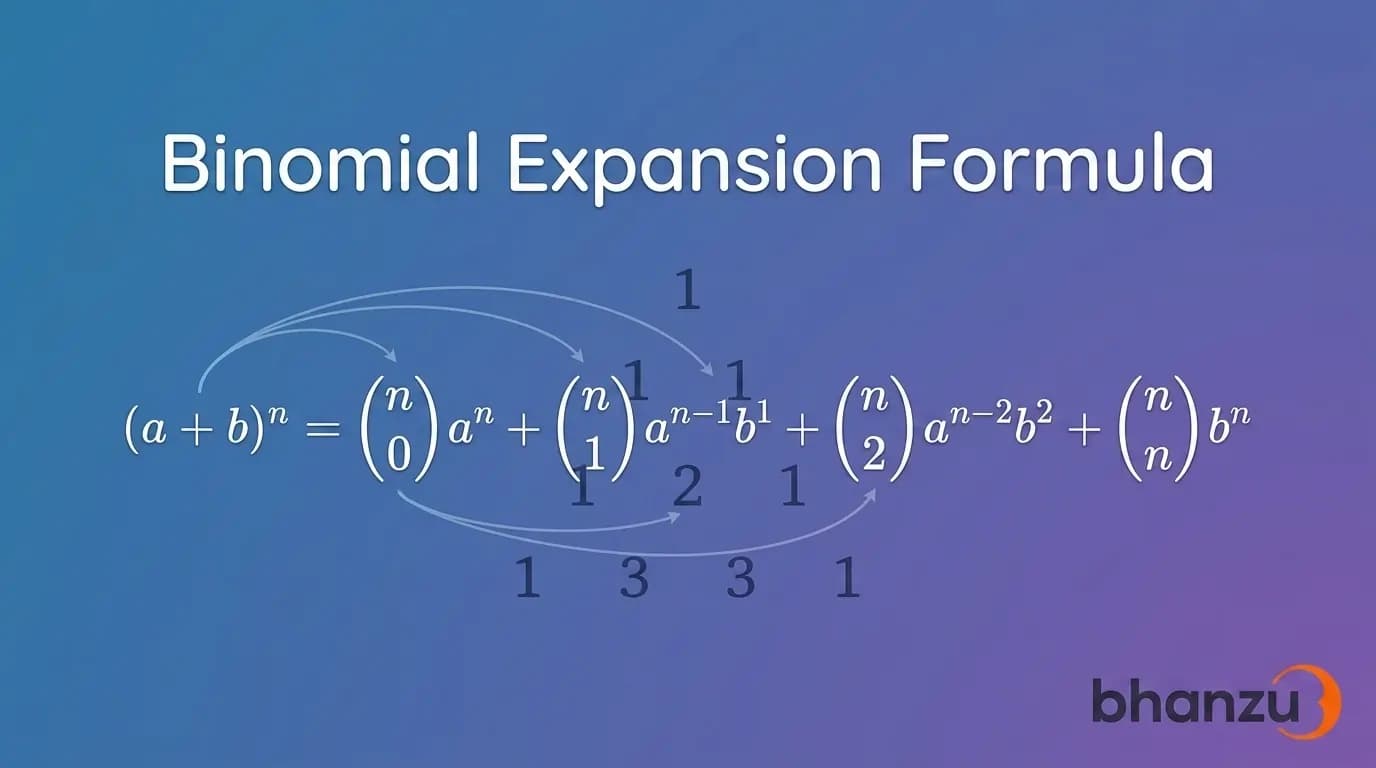
What Is the Binomial Expansion Formula?
The binomial expansion formula is the rule for expanding a binomial expression (x + y) raised to a power n into a sum of terms. Each term in the expansion contains a binomial coefficient and decreasing powers of x paired with increasing powers of y.
The Formula
For any non-negative integer n:
(x + y)ⁿ = ⁿC₀ xⁿ y⁰ + ⁿC₁ xⁿ⁻¹ y¹ + ⁿC₂ xⁿ⁻² y² + ... + ⁿCₙ x⁰ yⁿ
In summation notation:
(x + y)ⁿ = Σₖ₌₀ⁿ ⁿCₖ xⁿ⁻ᵏ yᵏ
The expansion has (n + 1) terms.
Variable Key
Symbol | Meaning |
|---|---|
x | The first term of the binomial |
y | The second term of the binomial |
n | The non-negative integer power the binomial is raised to |
k | The index of the term, running from 0 to n |
ⁿCₖ | The binomial coefficient, calculated as n! / [k!(n − k)!] |
n! | n factorial, equal to n × (n − 1) × (n − 2) × ... × 2 × 1 |
Σ | Summation operator — adds terms from k = 0 to k = n |
Structure of a Single Term
Every term in the expansion of (x + y)ⁿ has three parts: a binomial coefficient, a power of x, and a power of y.
The two exponents in any term always sum to n. If x has the power 4 and y has the power 3, then n must be 7. This rule lets you check any term for arithmetic errors before continuing.
When to Use the Binomial Expansion Formula
Use the formula when a binomial is raised to a power large enough that direct multiplication is impractical. Squaring a binomial can be done by hand using (a + b)² = a² + 2ab + b². Cubing one is also tractable. Beyond the cube - (a + b)⁵, (a + b)¹⁰, (2x − 3y)⁷ - the formula is the standard method.
The binomial expansion formula appears in NCERT Class 11 Mathematics Chapter 7, CBSE and ICSE curricula at the same level, US Algebra 2 and Pre-Calculus, and UK A-level Pure Mathematics Year 1. It is foundational for combinatorics, probability, and the binomial series in calculus.
Binomial Theorem vs. Binomial Expansion Formula
The two terms are often used as if they mean the same thing. They do not.
Binomial Theorem | Binomial Expansion Formula |
|---|---|
The mathematical statement that (x + y)ⁿ can be written as a finite sum of terms involving binomial coefficients. | The explicit equation used to compute that sum: (x + y)ⁿ = Σ ⁿCₖ xⁿ⁻ᵏ yᵏ. |
A general result, established by induction or combinatorial argument. | The operational tool derived from the theorem. |
Applies to non-negative integer powers (and, in generalised form, to all real powers). | The same — but written for direct computation. |
The formula is the working form of the theorem. The theorem says the expansion exists and has a specific structure; the formula tells you how to write it down.
Why the Binomial Coefficients Appear
The numbers ⁿCₖ are not chosen arbitrarily. They count something specific.
Take (x + y)³. Written out, it is (x + y)(x + y)(x + y). When the three brackets multiply, every term in the result comes from picking either x or y from each bracket. To get x²y, you have to pick y from exactly one of the three brackets and x from the other two. The number of ways to do that is ³C₁ = 3 — which is why the coefficient of x²y in the expansion of (x + y)³ is 3.
This combinatorial meaning is what ⁿCₖ measures. In the expansion of (x + y)ⁿ, the coefficient of xⁿ⁻ᵏyᵏ is the number of ways to choose which k of the n brackets contribute a y. That number is ⁿCₖ. Pascal's triangle, the formula n! / [k!(n − k)!], and the combinatorial count are three views of the same quantity.
Worked Example: Expand (2x + 3)⁵
Identify the values: first term = 2x, second term = 3, n = 5.
Apply the formula:
(2x + 3)⁵ = ⁵C₀ (2x)⁵ (3)⁰ + ⁵C₁ (2x)⁴ (3)¹ + ⁵C₂ (2x)³ (3)² + ⁵C₃ (2x)² (3)³ + ⁵C₄ (2x)¹ (3)⁴ + ⁵C₅ (2x)⁰ (3)⁵
Compute each binomial coefficient:
⁵C₀ = 1, ⁵C₁ = 5, ⁵C₂ = 10, ⁵C₃ = 10, ⁵C₄ = 5, ⁵C₅ = 1
Compute each term:
⁵C₀ (2x)⁵ (3)⁰ = 1 · 32x⁵ · 1 = 32x⁵
⁵C₁ (2x)⁴ (3)¹ = 5 · 16x⁴ · 3 = 240x⁴
⁵C₂ (2x)³ (3)² = 10 · 8x³ · 9 = 720x³
⁵C₃ (2x)² (3)³ = 10 · 4x² · 27 = 1080x²
⁵C₄ (2x)¹ (3)⁴ = 5 · 2x · 81 = 810x
⁵C₅ (2x)⁰ (3)⁵ = 1 · 1 · 243 = 243
Sum the terms:
Final answer: (2x + 3)⁵ = 32x⁵ + 240x⁴ + 720x³ + 1080x² + 810x + 243
Reference Table: Expansions of (a + b)ⁿ for n = 0 to n = 10
n | (a + b)ⁿ |
|---|---|
0 | 1 |
1 | a + b |
2 | a² + 2ab + b² |
3 | a³ + 3a²b + 3ab² + b³ |
4 | a⁴ + 4a³b + 6a²b² + 4ab³ + b⁴ |
5 | a⁵ + 5a⁴b + 10a³b² + 10a²b³ + 5ab⁴ + b⁵ |
6 | a⁶ + 6a⁵b + 15a⁴b² + 20a³b³ + 15a²b⁴ + 6ab⁵ + b⁶ |
7 | a⁷ + 7a⁶b + 21a⁵b² + 35a⁴b³ + 35a³b⁴ + 21a²b⁵ + 7ab⁶ + b⁷ |
8 | a⁸ + 8a⁷b + 28a⁶b² + 56a⁵b³ + 70a⁴b⁴ + 56a³b⁵ + 28a²b⁶ + 8ab⁷ + b⁸ |
9 | a⁹ + 9a⁸b + 36a⁷b² + 84a⁶b³ + 126a⁵b⁴ + 126a⁴b⁵ + 84a³b⁶ + 36a²b⁷ + 9ab⁸ + b⁹ |
10 | a¹⁰ + 10a⁹b + 45a⁸b² + 120a⁷b³ + 210a⁶b⁴ + 252a⁵b⁵ + 210a⁴b⁶ + 120a³b⁷ + 45a²b⁸ + 10ab⁹ + b¹⁰ |
For (a − b)ⁿ, the structure is identical but signs alternate: the kᵗʰ term carries (−1)ᵏ.
Pascal's Triangle
The coefficients in row n of Pascal's triangle are exactly ⁿC₀, ⁿC₁, ..., ⁿCₙ. Each row begins and ends with 1; every other entry is the sum of the two entries directly above it.
Pascal's triangle is an alternative to computing ⁿCₖ by factorial. For small n, reading coefficients off the triangle is faster than evaluating n! / [k!(n − k)!].
Special Forms of the Formula
Expansion of (1 + x)ⁿ for natural n
When the first term is 1, the formula simplifies:
(1 + x)ⁿ = 1 + nx + [n(n − 1)/2!] x² + [n(n − 1)(n − 2)/3!] x³ + ... + xⁿ
Use this form when one of the binomial's terms is 1 — common in approximation problems and probability.
Expansion of (1 + x)ⁿ for rational or negative n
The formula extends to rational and negative powers as an infinite series:
(1 + x)ⁿ = 1 + nx + [n(n − 1)/2!] x² + [n(n − 1)(n − 2)/3!] x³ + ...
Validity: the series converges only when |x| < 1.
This form is used to expand expressions like √(1 + x), 1/(1 + x), or (1 + x)⁻³. For non-integer n, the expansion does not terminate — it produces infinitely many terms. Truncate after the required number of terms for approximations.
Useful Formulas Derived from the Expansion
Quantity | Formula |
|---|---|
(r + 1)ᵗʰ term (general term) | Tᵣ₊₁ = ⁿCᵣ xⁿ⁻ʳ yʳ |
Number of terms in (x + y)ⁿ | n + 1 |
Middle term when n is even | The (n/2 + 1)ᵗʰ term |
Middle terms when n is odd | The ((n + 1)/2)ᵗʰ and ((n + 3)/2)ᵗʰ terms |
Sum of all coefficients in (x + y)ⁿ | 2ⁿ (set x = y = 1) |
Symmetry of coefficients | ⁿCᵣ = ⁿCₙ₋ᵣ |
Sum of even-indexed coefficients | 2ⁿ⁻¹ |
Sum of odd-indexed coefficients | 2ⁿ⁻¹ |
Common Mistakes
Sign errors when expanding (a − b)ⁿ
The signs in the expansion of (a − b)ⁿ alternate: positive for even k, negative for odd k. Treating (a − b)ⁿ as if it were (a + b)ⁿ is the most common error. The correct expansion of (a − b)⁵ is a⁵ − 5a⁴b + 10a³b² − 10a²b³ + 5ab⁴ − b⁵, not the all-positive version.
Off-by-one errors in term indexing
The (r + 1)ᵗʰ term corresponds to r in the formula — not r itself. To find the 5ᵗʰ term, use r = 4 in Tᵣ₊₁ = ⁿCᵣ xⁿ⁻ʳ yʳ. Many students substitute r = 5 and arrive at the 6ᵗʰ term by mistake.
Miscounting the middle term
When n is even, there is exactly one middle term — the (n/2 + 1)ᵗʰ. When n is odd, there are two middle terms. A common mistake is applying the even-n rule to an odd-n expansion (or vice versa).
Applying the natural-n formula to fractional or negative n
(x + y)ⁿ = Σ ⁿCₖ xⁿ⁻ᵏ yᵏ holds when n is a non-negative integer and the expansion terminates after n + 1 terms. For fractional or negative n, use the special form (1 + x)ⁿ with the validity condition |x| < 1, and accept that the expansion is infinite.
Forgetting to raise the coefficient inside the binomial
In an expansion like (2x + 3)⁵, students sometimes treat 2x as if it were just x. Each occurrence of 2x must be raised to its full power: (2x)⁵ = 32x⁵, not x⁵. The same applies to numerical second terms — (3)² = 9, not 3.

Was this article helpful?
Your feedback helps us write better content