
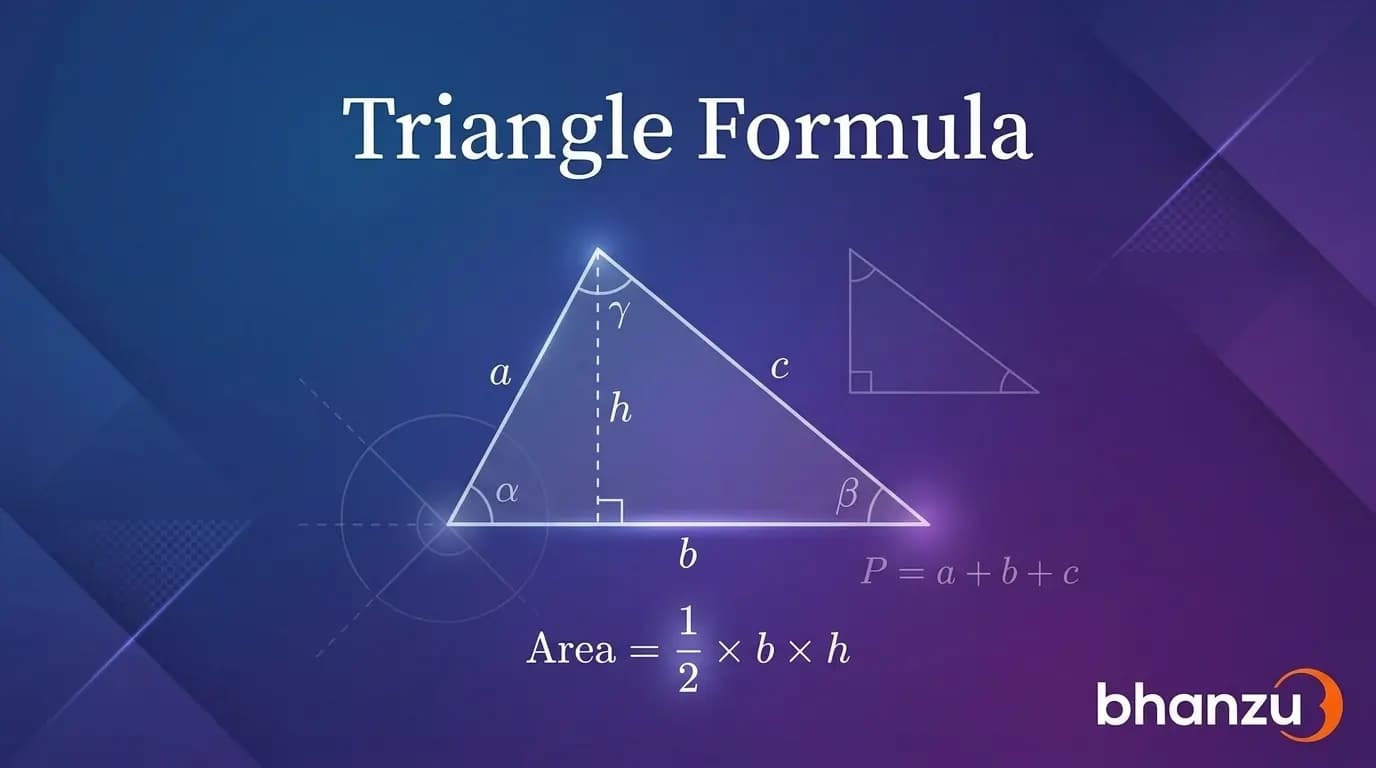
A triangle formula is any equation used to calculate a triangle's area, perimeter, or unknown side or angle. The two most widely used are A = ½ × b × h (area) and P = a + b + c (perimeter), with several specialised formulas for specific triangle types and known information.
All Triangle Formulas at a Glance
The table below covers every standard triangle formula taught in school geometry, organised by what you're calculating and what information you already have.
What You're Calculating | Formula | When to Use |
|---|---|---|
Area (general) | A = ½ × b × h | Base and perpendicular height known |
Area (Heron's) | A = √[s(s − a)(s − b)(s − c)] | All three sides known |
Area (using angle) | A = ½ × a × b × sin C | Two sides and included angle known |
Area (equilateral) | A = (√3/4) × a² | Equilateral, side known |
Area (right) | A = ½ × leg₁ × leg₂ | Right triangle, both legs known |
Perimeter (general) | P = a + b + c | Any triangle, all three sides known |
Perimeter (equilateral) | P = 3a | Equilateral |
Perimeter (isosceles) | P = 2a + b | Isosceles (a = equal side, b = base) |
The rest of this article explains each formula with a worked example and shows when to use which one.
What Is a Triangle?
A triangle is a closed two-dimensional polygon with three sides, three vertices, and three interior angles. The three interior angles always sum to 180°.
Two rules govern every triangle: the angle sum property (interior angles total 180°) and the triangle inequality theorem (the sum of any two sides is greater than the third). Without both conditions, three line segments cannot form a triangle.
Types of Triangles
Triangles can be classified two ways — by side lengths and by angle measures. Every triangle has both classifications at the same time. A triangle with two equal sides and one 90° angle is a right isosceles triangle; a triangle with three different sides and all angles below 90° is an acute scalene triangle.
By Sides
Type | Sides | Angles |
|---|---|---|
Equilateral | All three equal | All three 60° |
Isosceles | Two equal | Two equal (opposite the equal sides) |
Scalene | All three different | All three different |
By Angles
Type | Angle Property |
|---|---|
Acute | All three angles less than 90° |
Right | One angle equals exactly 90° |
Obtuse | One angle greater than 90° |
A right scalene triangle, an acute equilateral triangle, an obtuse isosceles triangle — all are valid combinations.
Area of a Triangle Formula
The area of a triangle is the space enclosed by its three sides, measured in square units. The general formula is:
A = ½ × b × h
Variable | Meaning |
|---|---|
A | Area of the triangle |
b | Length of the base (any chosen side) |
h | Perpendicular height from the base to the opposite vertex |
The base and height must be perpendicular. The slanted side of a triangle is not the height unless the triangle is a right triangle and the slanted side happens to be one of the legs.
The ½ in the formula comes from the fact that any triangle is exactly half of a parallelogram with the same base and height.
Equilateral Triangle Area Formula
For an equilateral triangle with side length a:
A = (√3/4) × a²
This is derived from the general formula A = ½ × b × h, with the height of an equilateral triangle equal to (√3/2) × a. The height comes from splitting the triangle into two 30-60-90 right triangles and applying the Pythagorean theorem.
Worked example: Find the area of an equilateral triangle with side 6 cm.
A = (√3/4) × 6² A = (√3/4) × 36 A = 9√3 ≈ 15.59 cm²
Isosceles Triangle Area Formula
For an isosceles triangle with two equal sides of length a and base b:
A = (b/4) × √(4a² − b²)
This formula is derived from A = ½ × b × h and the Pythagorean theorem applied to the altitude dropped from the apex to the midpoint of the base.
Worked example: Find the area of an isosceles triangle with equal sides of 5 cm and a base of 6 cm.
A = (6/4) × √(4 × 25 − 36) A = 1.5 × √(100 − 36) A = 1.5 × √64 A = 1.5 × 8 = 12 cm²
Right Triangle Area Formula
For a right triangle with legs a and b (the two sides that form the right angle):
A = ½ × a × b
The two legs are perpendicular by definition, so they serve as base and height directly.
Worked example: A right triangle has legs of 3 cm and 4 cm.
A = ½ × 3 × 4 = 6 cm²
Heron's Formula (Any Triangle, All Three Sides Known)
When all three side lengths are known but the height is not, use Heron's formula:
A = √[s(s − a)(s − b)(s − c)]
where s = (a + b + c) / 2 is the semi-perimeter.
Variable | Meaning |
|---|---|
A | Area of the triangle |
a, b, c | Lengths of the three sides |
s | Semi-perimeter, equal to half the perimeter |
The formula is named after Hero of Alexandria, who recorded it in the 1st century CE.
Worked example: Find the area of a triangle with sides 5 cm, 6 cm, and 7 cm.
s = (5 + 6 + 7) / 2 = 9 A = √[9 × (9 − 5) × (9 − 6) × (9 − 7)] A = √[9 × 4 × 3 × 2] A = √216 ≈ 14.70 cm²
Area Using Two Sides and an Included Angle
When two sides and the angle between them are known, use:
A = ½ × a × b × sin C
where a and b are the two sides and C is the angle between them (the included angle).
Worked example: Find the area of a triangle with a = 8 cm, b = 10 cm, and C = 30°.
A = ½ × 8 × 10 × sin 30° A = ½ × 8 × 10 × 0.5 = 20 cm²
Perimeter of a Triangle Formula
The perimeter of a triangle is the total distance around it — the sum of the three side lengths.
P = a + b + c
Variable | Meaning |
|---|---|
P | Perimeter of the triangle |
a, b, c | Lengths of the three sides |
The semi-perimeter, denoted s, is half the perimeter: s = (a + b + c) / 2. It appears in Heron's formula.
Equilateral Triangle Perimeter
For an equilateral triangle with side a:
P = 3a
Worked example: Side = 7 cm. P = 3 × 7 = 21 cm.
Isosceles Triangle Perimeter
For an isosceles triangle with equal sides a and base b:
P = 2a + b
Worked example: Equal sides of 9 cm and base of 4 cm. P = 2(9) + 4 = 22 cm.
Right Triangle Perimeter
If only the two legs (a and b) are known, the hypotenuse is found using the Pythagorean theorem and added:
P = a + b + √(a² + b²)
Worked example: Legs of 3 cm and 4 cm. Hypotenuse = √(9 + 16) = √25 = 5 P = 3 + 4 + 5 = 12 cm
Scalene Triangle Perimeter
A scalene triangle has all three sides different. Its perimeter is the standard P = a + b + c, with no shortcut.
Which Triangle Formula Should You Use?
The correct formula depends on what information you already have. Use this decision table:
What You Know | Formula to Use |
|---|---|
Base and perpendicular height | A = ½ × b × h |
All three sides (no height) | Heron's formula |
Two sides and the angle between them | A = ½ × a × b × sin C |
Equilateral triangle, side length | A = (√3/4) × a² |
Right triangle, two legs | A = ½ × leg₁ × leg₂ |
All three side lengths (perimeter) | P = a + b + c |
Equilateral triangle, side length (perimeter) | P = 3a |
Right triangle, two legs (perimeter) | P = a + b + √(a² + b²) |
This covers the full set of standard problems in school-level geometry.
Related Formulas and Theorems
Several theorems and formulas appear alongside triangle formulas in problem-solving:
Formula / Theorem | Statement | When It Applies |
|---|---|---|
Pythagorean Theorem | a² + b² = c² | Right triangles only; finds the missing side |
Triangle Inequality Theorem | a + b > c (for any pair of sides) | Tests whether three side lengths can form a triangle |
Angle Sum Property | A + B + C = 180° | Every triangle |
Sine Rule | a/sin A = b/sin B = c/sin C | Any triangle, relates sides to opposite angles |
Cosine Rule | c² = a² + b² − 2ab × cos C | Any triangle, when SAS or SSS information is known |
Semi-perimeter | s = (a + b + c) / 2 | Used in Heron's formula |
Common Mistakes When Using Triangle Formulas
Using a slanted side as the height. The height must be perpendicular to the base. In a non-right triangle, the height is a separate measurement, not one of the visible sides.
Confusing area (½ × b × h) with perimeter (a + b + c). Area uses square units; perimeter uses linear units.
Applying the equilateral area formula to a non-equilateral triangle. (√3/4) × a² only works when all three sides are equal.
Forgetting to convert measurements to the same unit before calculating. A base in metres and a height in centimetres will give the wrong answer.
Using Heron's formula with only two sides. Heron's formula requires all three.
Worked Examples
Example 1. A scalene triangle has sides 7 cm, 8 cm, and 9 cm. Find its area and perimeter.
Given: a = 7 cm, b = 8 cm, c = 9 cm Formulas to use: P = a + b + c (perimeter); Heron's formula A = √[s(s − a)(s − b)(s − c)] (area, since no height is given)
Step 1: Perimeter. P = a + b + c P = 7 + 8 + 9 P = 24 cm
Step 2: Semi-perimeter. s = P / 2 s = 24 / 2 s = 12
Step 3: Apply Heron's formula. A = √[s(s − a)(s − b)(s − c)] A = √[12 × (12 − 7) × (12 − 8) × (12 − 9)] A = √[12 × 5 × 4 × 3] A = √720
Step 4: Simplify. √720 = √(144 × 5) = 12√5 ≈ 26.83
Final answer: Perimeter = 24 cm, Area ≈ 26.83 cm²
Example 2. A right triangle has legs of 6 cm and 8 cm. Find its hypotenuse, area, and perimeter.
Given: leg a = 6 cm, leg b = 8 cm, the angle between them = 90° Formulas to use: Pythagorean theorem (find hypotenuse); A = ½ × leg₁ × leg₂ (area); P = a + b + c (perimeter)
Step 1: Find the hypotenuse using the Pythagorean theorem. c² = a² + b² c² = 6² + 8² c² = 36 + 64 c² = 100 c = √100 = 10 cm
Step 2: Find the area. A = ½ × leg₁ × leg₂ A = ½ × 6 × 8 A = 24 cm²
Step 3: Find the perimeter. P = a + b + c P = 6 + 8 + 10 P = 24 cm
Final answer: Hypotenuse = 10 cm, Area = 24 cm², Perimeter = 24 cm
Example 3. An equilateral triangle has a side length of 10 cm. Find its area and perimeter.
Given: a = 10 cm (all three sides equal) Formulas to use: A = (√3/4) × a² (equilateral area); P = 3a (equilateral perimeter)
Step 1: Find the perimeter. P = 3 × a P = 3 × 10 P = 30 cm
Step 2: Substitute into the equilateral area formula. A = (√3/4) × a² A = (√3/4) × 10² A = (√3/4) × 100 A = 25√3
Step 3: Approximate the value (√3 ≈ 1.732). A ≈ 25 × 1.732 A ≈ 43.30 cm²
Final answer: Perimeter = 30 cm, Area ≈ 43.30 cm²
Example 4. An isosceles triangle has two equal sides of 13 cm and a base of 10 cm. Find its area and perimeter.
Given: a = 13 cm (each equal side), b = 10 cm (base) Formulas to use: A = (b/4) × √(4a² − b²) (isosceles area); P = 2a + b (isosceles perimeter)
Step 1: Find the perimeter. P = 2a + b P = 2(13) + 10 P = 26 + 10 P = 36 cm
Step 2: Substitute into the isosceles area formula. A = (b/4) × √(4a² − b²) A = (10/4) × √(4 × 13² − 10²) A = 2.5 × √(4 × 169 − 100) A = 2.5 × √(676 − 100) A = 2.5 × √576
Step 3: Simplify. √576 = 24 A = 2.5 × 24 A = 60 cm²
Final answer: Perimeter = 36 cm, Area = 60 cm²
Example 5. A triangle has two sides of 6 cm and 9 cm with an included angle of 60° between them. Find its area.
Given: a = 6 cm, b = 9 cm, C = 60° (included angle) Formula to use: A = ½ × a × b × sin C (area using two sides and an included angle)
Step 1: Substitute into the formula. A = ½ × a × b × sin C A = ½ × 6 × 9 × sin 60°
Step 2: Evaluate sin 60°. sin 60° = √3 / 2
Step 3: Multiply. A = ½ × 6 × 9 × (√3 / 2) A = (½ × 6 × 9 × √3) / 2 A = (54√3) / 4 A = 13.5√3
Step 4: Approximate the value (√3 ≈ 1.732). A ≈ 13.5 × 1.732 A ≈ 23.38 cm²
Final answer: Area ≈ 23.38 cm²

Was this article helpful?
Your feedback helps us write better content