
What is Perimeter?
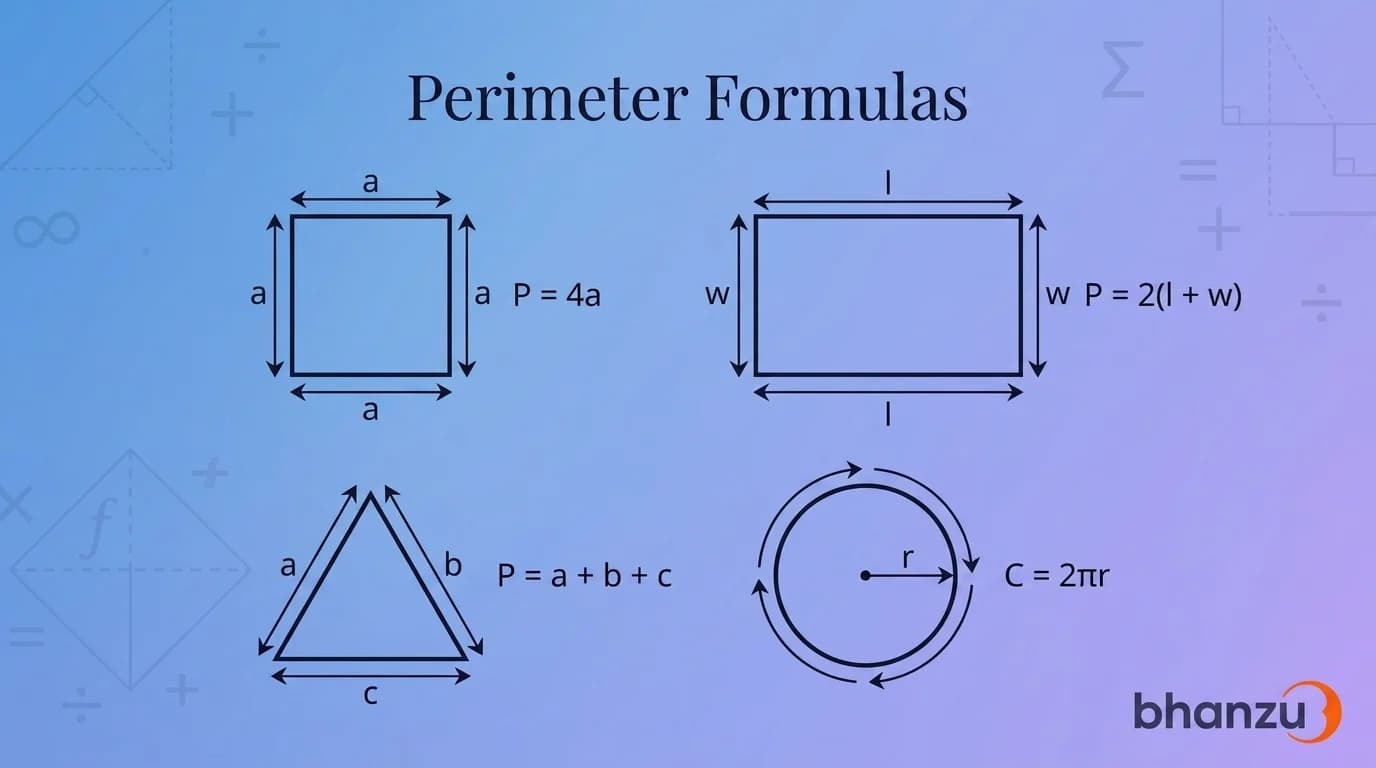
Perimeter is the total length of the boundary of a closed two-dimensional shape. It's measured in linear units - centimetres, metres, inches, feet - never in square units. The perimeter formulas below cover every standard 2D shape taught from elementary through high school.
For a circle, perimeter has a special name: circumference. Both terms describe the same idea — the distance around a shape - but circumference is reserved for circles and ellipses.
Master Formula Table
Shape | Perimeter Formula | Variables |
|---|---|---|
Square | P = 4a | a = side |
Rectangle | P = 2(l + w) | l = length, w = width |
Triangle (general) | P = a + b + c | a, b, c = three sides |
Equilateral Triangle | P = 3a | a = side |
Isosceles Triangle | P = 2a + b | a = equal sides, b = base |
Right Triangle | P = a + b + √(a² + b²) | a, b = legs |
Parallelogram | P = 2(a + b) | a, b = adjacent sides |
Rhombus (by side) | P = 4a | a = side |
Rhombus (by diagonals) | P = 2√(d₁² + d₂²) | d₁, d₂ = diagonals |
Trapezoid / Trapezium | P = a + b + c + d | four sides |
Kite | P = 2(a + b) | a, b = pairs of equal sides |
Circle (circumference) | C = 2πr or C = πd | r = radius, d = diameter |
Semicircle | P = πr + 2r | r = radius |
Regular Polygon (by side) | P = n × s | n = number of sides, s = side |
Regular Polygon (by circumradius) | P = 2nR sin(180°/n) | R = circumradius |
Irregular Polygon | P = sum of all sides | — |
This table is the fast reference. The sections below give variable keys, derivation notes, and one worked example per shape.
How to Identify a Shape Before Choosing a Formula
If the shape isn't already named, this table identifies it by its features.
If the shape has... | It's a... |
|---|---|
4 equal sides, 4 right angles | Square |
4 sides, opposite sides equal, 4 right angles | Rectangle |
4 sides, opposite sides parallel, no right angles required | Parallelogram |
4 equal sides, no right angles required | Rhombus |
4 sides, exactly one pair parallel | Trapezoid (Trapezium) |
4 sides, two pairs of adjacent equal sides | Kite |
3 sides | Triangle |
Curved boundary, all points equidistant from center | Circle |
Half a circle (curved edge + straight diameter) | Semicircle |
All sides and angles equal (5+ sides) | Regular Polygon |
Sides of unequal length | Irregular Polygon |
Perimeter of a Square
A square has four equal sides and four right angles.
Formula:
P = 4a
Variable Key:
Variable | Meaning |
|---|---|
P | Perimeter |
a | Length of one side |
Worked Example:
A square has a side of 6 cm. P = 4 × 6 = 24 cm
Perimeter of a Rectangle
A rectangle has four sides, with opposite sides equal in length and four right angles.
Formula:
P = 2(l + w)
Variable Key:
Variable | Meaning |
|---|---|
P | Perimeter |
l | Length (the longer side) |
w | Width (the shorter side) |
Worked Example:
A rectangle has length 8 cm and width 5 cm. P = 2(8 + 5) = 2 × 13 = 26 cm
Perimeter of a Triangle
A triangle has three sides. The general formula adds all three.
Formula:
P = a + b + c
Variable Key:
Variable | Meaning |
|---|---|
P | Perimeter |
a, b, c | Lengths of the three sides |
The general formula works for every triangle. Specific triangle types have shorter forms.
Scalene Triangle
All three sides differ in length.
P = a + b + c
Example: sides 3 cm, 4 cm, 5 cm. P = 3 + 4 + 5 = 12 cm
Isosceles Triangle
Two sides are equal. With equal sides of length a and base b:
P = 2a + b
Example: equal sides 5 cm, base 4 cm. P = 2(5) + 4 = 14 cm
Equilateral Triangle
All three sides are equal.
P = 3a
Example: side 7 cm. P = 3 × 7 = 21 cm
Right Triangle
A right triangle has two perpendicular legs and a hypotenuse. With legs a and b, the hypotenuse equals √(a² + b²) by the Pythagorean theorem.
P = a + b + √(a² + b²)
Example: legs 3 cm and 4 cm. Hypotenuse = √(9 + 16) = √25 = 5 cm. P = 3 + 4 + 5 = 12 cm
Perimeter of a Parallelogram
A parallelogram has four sides, with opposite sides parallel and equal in length.
Formula:
P = 2(a + b)
Variable Key:
Variable | Meaning |
|---|---|
P | Perimeter |
a | Length of one pair of parallel sides |
b | Length of the other pair |
Worked Example:
A parallelogram has adjacent sides 7 cm and 4 cm. P = 2(7 + 4) = 2 × 11 = 22 cm
Perimeter of a Rhombus
A rhombus has four equal sides. Two formulas apply, depending on what's given.
When all sides are known
P = 4a
Variable | Meaning |
|---|---|
P | Perimeter |
a | Length of one side |
Example: side 9 cm. P = 4 × 9 = 36 cm
(The formula matches the square's because both shapes have four equal sides — a square is technically a special case of a rhombus.)
When only the diagonals are known
P = 2√(d₁² + d₂²)
Variable | Meaning |
|---|---|
P | Perimeter |
d₁ | Length of one diagonal |
d₂ | Length of the other diagonal |
Derivation: The diagonals of a rhombus bisect each other at right angles. Each side is the hypotenuse of a right triangle with legs d₁/2 and d₂/2. So one side equals √((d₁/2)² + (d₂/2)²) = (1/2)√(d₁² + d₂²). Multiplying by 4 (since there are four equal sides) gives 2√(d₁² + d₂²).
Example: diagonals 6 cm and 8 cm. P = 2√(36 + 64) = 2√100 = 2 × 10 = 20 cm
Perimeter of a Trapezoid (Trapezium)
A trapezoid has four sides, with exactly one pair parallel. The same shape is called a trapezium in UK and Indian curricula and a trapezoid in US curricula. The formula is identical.
Formula:
P = a + b + c + d
Variable Key:
Variable | Meaning |
|---|---|
P | Perimeter |
a, b | The two parallel sides |
c, d | The two non-parallel sides |
Worked Example:
A trapezoid has sides 7 cm, 5 cm, 4 cm, and 6 cm. P = 7 + 5 + 4 + 6 = 22 cm
Perimeter of a Kite
A kite has four sides arranged in two pairs of adjacent equal sides.
Formula:
P = 2(a + b)
Variable Key:
Variable | Meaning |
|---|---|
P | Perimeter |
a | Length of one pair of equal adjacent sides |
b | Length of the other pair |
Worked Example:
A kite has pairs of sides measuring 5 cm and 7 cm. P = 2(5 + 7) = 24 cm
Perimeter (Circumference) of a Circle
A circle is the set of all points equidistant from a center. Its perimeter is called the circumference.
Using the radius
C = 2πr
Variable | Meaning |
|---|---|
C | Circumference (perimeter) |
r | Radius — the distance from the center to the edge |
π | Pi ≈ 3.14159 (or 22/7 for quick approximations) |
Example: radius 7 cm. Using π = 22/7: C = 2 × (22/7) × 7 = 44 cm
Using the diameter
C = πd
The diameter is twice the radius (d = 2r), so this formula is mathematically the same as C = 2πr.
Example: diameter 14 cm. Using π = 22/7: C = (22/7) × 14 = 44 cm
Perimeter of a Semicircle
A semicircle is half a circle, formed by cutting a circle along its diameter. Its perimeter includes both the curved edge AND the straight diameter — not just the curved part.
Formula:
P = πr + 2r
This can also be written as P = r(π + 2).
Variable Key:
Variable | Meaning |
|---|---|
P | Perimeter |
r | Radius |
πr | The curved edge (half the full circumference) |
2r | The straight edge (the diameter) |
Worked Example:
A semicircle has a radius of 7 cm. Using π = 22/7:
Curved edge = (22/7) × 7 = 22 cm
Straight edge = 2 × 7 = 14 cm
P = 22 + 14 = 36 cm
A common mistake: forgetting the straight edge. The formula πr alone gives only the curved arc, not the closed shape.
Perimeter of a Regular Polygon
A regular polygon has all sides equal and all angles equal.
When the side length is known
P = n × s
Variable | Meaning |
|---|---|
P | Perimeter |
n | Number of sides |
s | Length of one side |
Example: a regular pentagon (5 sides) with side 6 cm. P = 5 × 6 = 30 cm
When the circumradius is known
When only the distance from the center of the polygon to a vertex (the circumradius, R) is known:
P = 2nR sin(180°/n)
Variable | Meaning |
|---|---|
P | Perimeter |
n | Number of sides |
R | Circumradius — distance from center to vertex |
This formula uses trigonometry. Each side of the polygon equals 2R sin(180°/n); multiplying by n gives the full perimeter.
Example: a regular hexagon (n = 6) inscribed in a circle of radius 4 cm. P = 2 × 6 × 4 × sin(180°/6) = 48 × sin(30°) = 48 × 0.5 = 24 cm
Perimeter of an Irregular Polygon
An irregular polygon has sides of unequal length. There's no shortcut — every side has to be added.
Formula:
P = sum of all sides
Worked Example:
A 5-sided irregular polygon has sides 3 cm, 4 cm, 5 cm, 6 cm, and 7 cm. P = 3 + 4 + 5 + 6 + 7 = 25 cm
If the polygon is given only by coordinate points (vertices on a grid), the length of each side has to be calculated using the distance formula before summing.
Quick Reference: Common Regular Polygons
Shape | Number of Sides | Formula | Example (side = 5) |
|---|---|---|---|
Equilateral Triangle | 3 | P = 3s | 15 |
Square | 4 | P = 4s | 20 |
Regular Pentagon | 5 | P = 5s | 25 |
Regular Hexagon | 6 | P = 6s | 30 |
Regular Heptagon | 7 | P = 7s | 35 |
Regular Octagon | 8 | P = 8s | 40 |
Regular Nonagon | 9 | P = 9s | 45 |
Regular Decagon | 10 | P = 10s | 50 |
Perimeter vs Circumference: What's the Difference?
Circumference is the perimeter of a circle. The two terms describe the same concept — the total length of a shape's boundary. Convention reserves circumference for circles and ellipses, while perimeter applies to polygons and other shapes with straight sides. Both terms refer to the same measurement; only the convention of usage differs.
Common Mistakes When Calculating Perimeter
Four mistakes appear repeatedly in classroom work.
Confusing perimeter with area. Perimeter is one-dimensional and measured in linear units (cm, m, inches). Area is two-dimensional and measured in square units (cm², m², square inches). A unit error usually signals which of the two concepts is being confused.
Forgetting the diameter on a semicircle. The curved edge alone is πr. The full perimeter of a semicircle is πr + 2r. Skipping the +2r gives only the arc — not a closed shape.
Doubling π for a circle. The formula is C = 2πr or C = πd — not 2πd. The factor of 2 in the radius version exists because the diameter is twice the radius. Applying it again to the diameter version doubles the answer.
Mixing units before adding. Sides given in centimetres and metres must be converted to a single unit before summing. Adding 3 cm + 0.05 m without conversion gives a meaningless number.
Curriculum References
Perimeter appears across major curriculum standards in elementary and middle school:
Curriculum | Where Perimeter Appears |
|---|---|
CCSS (US) | 3.MD.D.8 (Grade 3), 4.MD.A.3 (Grade 4) |
NCERT (India) | Class 6 Chapter 10 (Mensuration), Class 7 Chapter 11 |
UK National Curriculum | KS2 Year 4–6 (Measurement) |
Singapore Math | Primary 4 (Length) |

Was this article helpful?
Your feedback helps us write better content