
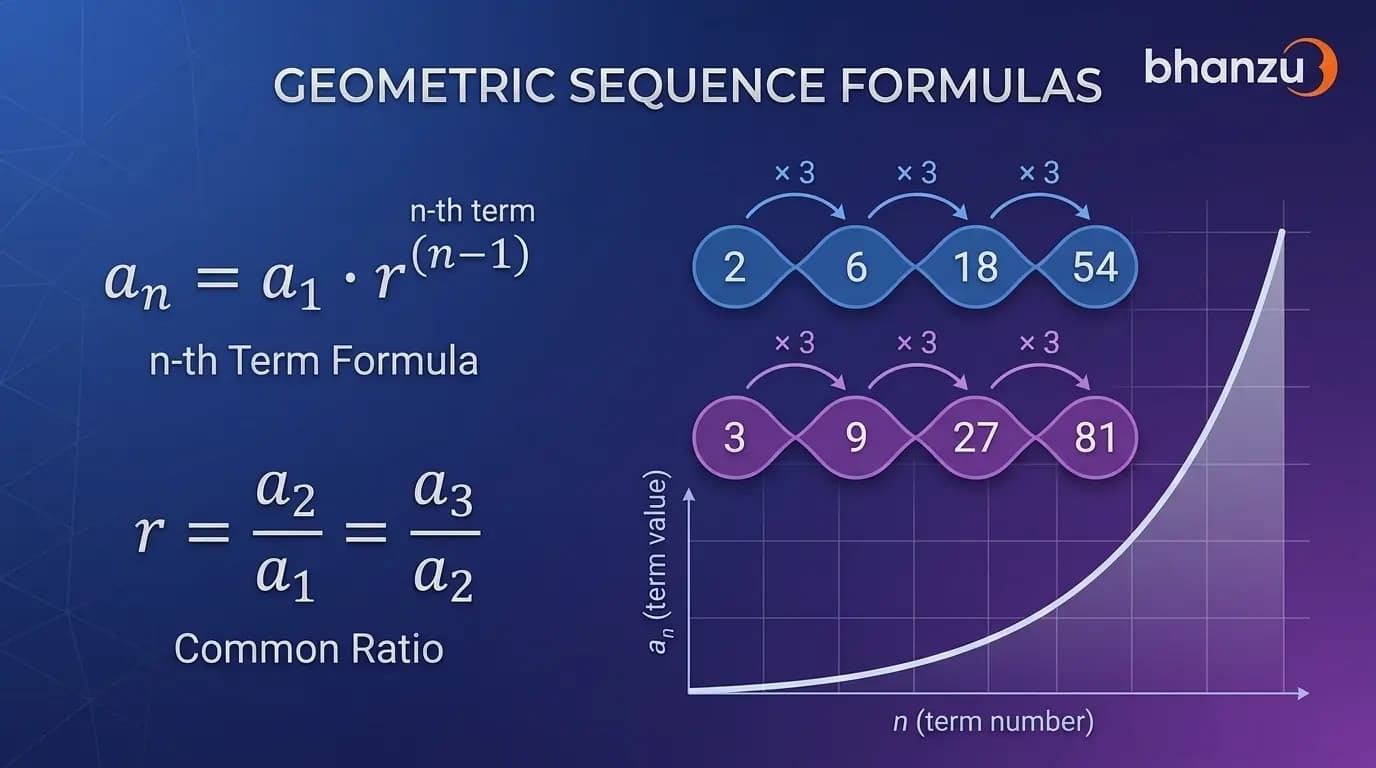
Geometric sequence formulas are the equations used to find any term in a geometric sequence and to compute the sum of its terms. There are three core formulas: the nth term formula, the sum of the first n terms, and the sum of an infinite geometric sequence. A geometric sequence is one where each term is the previous term multiplied by a fixed number called the common ratio.
Quick Reference: All Geometric Sequence Formulas
Formula | Equation | Condition |
|---|---|---|
nth term | aₙ = a · r^(n−1) | Any geometric sequence |
Sum of first n terms | Sₙ = a(1 − rⁿ)/(1 − r) | r ≠ 1 |
Sum of first n terms | Sₙ = na | r = 1 |
Infinite sum | S∞ = a/(1 − r) | |r| < 1 |
Infinite sum | Diverges (no finite value) | |r| ≥ 1 |
In every formula, a is the first term, r is the common ratio, and n is the number of terms.
nth Term Formula of a Geometric Sequence
The nth term formula:
aₙ = a · r^(n−1)
Variable Key
Variable | Meaning |
|---|---|
a | First term of the sequence |
r | Common ratio (any term divided by the previous term) |
n | Position of the term being found |
aₙ | The term at position n |
When to Use It
Use the nth term formula when the first term and common ratio are known, and a specific term is needed without listing every term before it. The exponent is (n − 1), not n — it counts how many times r has been multiplied to reach position n.
Some textbooks index sequences starting from a₀ instead of a₁. In that case, the formula becomes aₙ = a · rⁿ. Check the textbook's convention before applying the formula.
Worked Example
Find the 7th term of the sequence 3, 6, 12, 24, …
a = 3, r = 2, n = 7
a₇ = 3 · 2^(7−1) = 3 · 2⁶ = 3 · 64 = 192
Answer: a₇ = 192
Sum of the First n Terms Formula
The sum formulas:
Sₙ = a(1 − rⁿ)/(1 − r), when r ≠ 1
Sₙ = a(rⁿ − 1)/(r − 1), when r ≠ 1
Sₙ = na, when r = 1
The Two Forms Are the Same Formula
The first two forms produce identical answers. Multiplying both the numerator and denominator of a(1 − rⁿ)/(1 − r) by −1 gives a(rⁿ − 1)/(r − 1). Convention: use whichever form keeps the numerator positive. When |r| < 1, use the first form. When r > 1, use the second form.
Variable Key
Variable | Meaning |
|---|---|
a | First term |
r | Common ratio |
n | Number of terms being summed |
Sₙ | Sum of the first n terms |
When to Use It
Use the sum formula when the total of a known number of terms is needed without adding them one by one. It applies to any compound-growth or repeated-multiplication problem with a finite cutoff — population doubling over a fixed period, loan interest over a known number of payments, or the total reach of a chain message over a set number of rounds.
The r = 1 Special Case
When r = 1, every term in the sequence equals the first term: a, a, a, … Plugging r = 1 into Sₙ = a(1 − rⁿ)/(1 − r) produces 0/0, which is undefined. The actual sum is just a added to itself n times, so:
Sₙ = na, when r = 1
This is why the Quick Reference table treats r = 1 as a separate row.
How the Formula Is Derived
The derivation uses an algebraic trick: subtracting Sₙ from rSₙ cancels every term except the first and last. Worked through with real numbers using a = 2, r = 3, n = 4:
Step 1. Write out the sum.
S₄ = 2 + 6 + 18 + 54
Step 2. Multiply both sides by r = 3.
3S₄ = 6 + 18 + 54 + 162
Step 3. Subtract the first equation from the second.
3S₄ − S₄ = (6 + 18 + 54 + 162) − (2 + 6 + 18 + 54)
3S₄ − S₄ = 162 − 2
2S₄ = 160
S₄ = 80
Verify by direct addition: 2 + 6 + 18 + 54 = 80. ✓
The same logic in symbols:
Sₙ = a + ar + ar² + … + ar^(n−1)
rSₙ = ar + ar² + … + ar^(n−1) + arⁿ
rSₙ − Sₙ = arⁿ − a
Sₙ(r − 1) = a(rⁿ − 1)
Sₙ = a(rⁿ − 1)/(r − 1)
This is where the formula comes from. Every term in the middle cancels.
Worked Example
Find the sum of the first 6 terms of 5, 10, 20, 40, …
a = 5, r = 2, n = 6
Since r > 1, use the second form:
S₆ = 5(2⁶ − 1)/(2 − 1) = 5(64 − 1)/1 = 5 · 63 = 315
Answer: S₆ = 315
Sum of an Infinite Geometric Sequence
The infinite sum formula:
S∞ = a/(1 − r), when |r| < 1
Diverges (no finite sum), when |r| ≥ 1
Variable Key
Variable | Meaning |
|---|---|
a | First term |
r | Common ratio |
S∞ | Sum of all (infinitely many) terms |
Why |r| < 1 Is Required
When |r| < 1, each term is smaller than the one before it. The terms shrink toward zero, and the partial sums approach a finite limit. When |r| ≥ 1, the terms either stay the same size (|r| = 1) or grow (|r| > 1), so adding infinitely many of them produces a sum that grows without bound or oscillates without settling.
The convergence condition follows directly from the finite-sum formula. As n grows, rⁿ approaches 0 when |r| < 1. Substituting that into Sₙ = a(1 − rⁿ)/(1 − r) gives:
S∞ = a(1 − 0)/(1 − r) = a/(1 − r)
Worked Example
Find the sum of the infinite series 4 + 2 + 1 + 0.5 + 0.25 + …
a = 4, r = 0.5, |r| < 1, so the series converges.
S∞ = 4/(1 − 0.5) = 4/0.5 = 8
Answer: S∞ = 8
Recursive vs Explicit Formulas
A geometric sequence can be written in two formula forms — explicit and recursive.
Aspect | Explicit Formula | Recursive Formula |
|---|---|---|
Form | aₙ = a · r^(n−1) | aₙ = aₙ₋₁ · r, with a₁ = a |
What it does | Computes any term directly from its position | Computes each term from the previous one |
Best for | Jumping to a far-off term (e.g., the 50th) | Building the sequence step by step |
Drawback | Requires computing a power | Requires every prior term |
Use the explicit form when one specific term far in the sequence is needed. Use the recursive form when working through the sequence one term at a time, or when programming a loop.
Translation between the two forms is a Common Core standard requirement (CCSS HSF.BF.A.2) and is also covered in NCERT Class 11 Chapter 9.
Common Confusions
Geometric vs arithmetic sequence. Geometric uses multiplication (× r each step); arithmetic uses addition (+ d each step). Mixing the two formula sets is the most common error in problems involving sequences.
The two finite-sum forms. They are the same formula. Multiplying the numerator and denominator of
(1 − rⁿ)/(1 − r)by −1 gives(rⁿ − 1)/(r − 1). Use whichever form keeps the numerator positive.n vs n − 1 in the exponent. The nth term uses r^(n−1), not r^n. The exponent counts how many times r has been multiplied — which is one less than the position. The first term has been multiplied by r zero times (r⁰ = 1).
Infinite sum convergence. The infinite-sum formula only works when |r| < 1. Plugging in r = 2 or r = −1 produces a number, but that number is meaningless — the actual sum does not exist.
First-term notation. Some textbooks use
a, othersa₁, othersa₀(indexing from zero). The values are identical, but the exponent shifts: aₙ = a · r^(n−1) when indexing from a₁, or aₙ = a · rⁿ when indexing from a₀.
Related Formulas
Formula | Use |
|---|---|
Common ratio: r = aₙ / aₙ₋₁ | Find r from any two consecutive terms |
Geometric mean of a and b: √(a · b) | Find the middle term between two values |
nth term of arithmetic sequence: aₙ = a + (n−1)d | Adjacent topic — arithmetic sequences |
Sum of arithmetic sequence: Sₙ = n/2 · (2a + (n−1)d) | Adjacent topic |

Was this article helpful?
Your feedback helps us write better content