
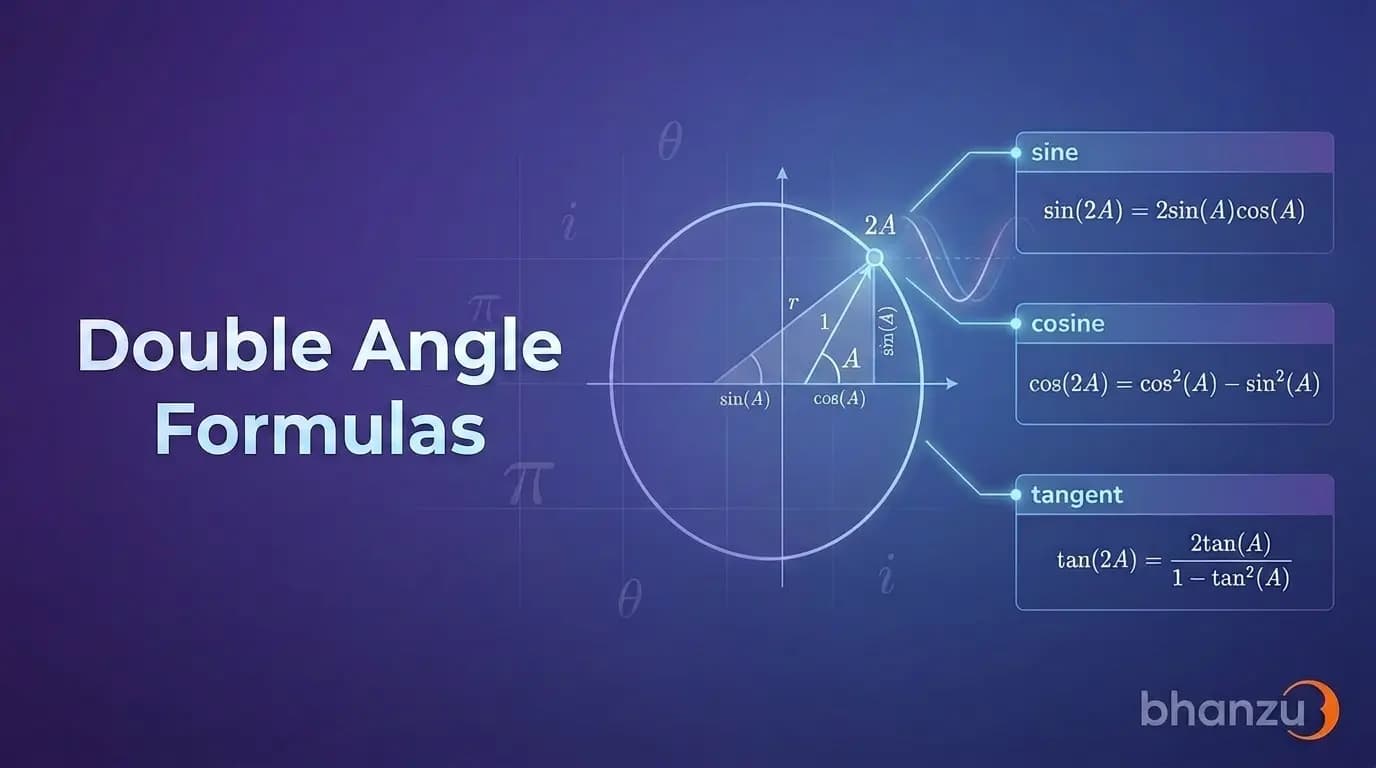
The double angle formulas are a set of three trigonometric identities that express sin 2θ, cos 2θ, and tan 2θ in terms of sin θ, cos θ, and tan θ. The cosine formula has three equivalent forms. Each identity also has a t-form expressed purely in terms of tan θ.
Double Angle Formulas at a Glance
Identity | Standard Form | t-Form (in tan θ) |
|---|---|---|
sin 2θ | 2 sin θ cos θ | 2 tan θ / (1 + tan²θ) |
cos 2θ | cos²θ − sin²θ | (1 − tan²θ) / (1 + tan²θ) |
tan 2θ | 2 tan θ / (1 − tan²θ) | — |
The three forms of cos 2θ are algebraically identical. The choice of which form to use depends on what information is given in the problem, covered in a later section.
Variable Key
Symbol | Meaning |
|---|---|
θ | The single angle, measured in degrees or radians |
2θ | The double angle — twice θ |
sin θ, cos θ, tan θ | The sine, cosine, and tangent of the single angle |
sin²θ | Shorthand for (sin θ)². Same convention for cos²θ and tan²θ. |
sin²θ + cos²θ = 1 | The Pythagorean identity, used to derive the alternate forms |
A common notation trap: sin²θ means (sin θ)², not sin(θ²). The two are completely different quantities.
The Three Double Angle Formulas
Double Angle Formula for Sine — sin 2θ
sin 2θ = 2 sin θ cos θ
The sine of a double angle equals twice the product of sin θ and cos θ. The t-form is:
sin 2θ = 2 tan θ / (1 + tan²θ)
The t-form is useful when only tan θ is known.
Double Angle Formulas for Cosine — cos 2θ (Three Forms)
The cosine of a double angle has three standard forms:
cos 2θ = cos²θ − sin²θ
cos 2θ = 1 − 2 sin²θ
cos 2θ = 2 cos²θ − 1
The second form follows from the first by replacing cos²θ with 1 − sin²θ. The third form follows from the first by replacing sin²θ with 1 − cos²θ. The t-form is:
cos 2θ = (1 − tan²θ) / (1 + tan²θ)
Double Angle Formula for Tangent — tan 2θ
tan 2θ = 2 tan θ / (1 − tan²θ)
This formula is undefined when tan²θ = 1, that is, when θ = 45° + 90°·n for any integer n. At those angles, 2θ is an odd multiple of 90°, where tan is undefined.
Derivation of Double Angle Formulas
The double angle formulas are special cases of the sum formulas, obtained by substituting α = β = θ.
Deriving sin 2θ from the Sine Sum Formula
Start with the sine sum formula:
sin(α + β) = sin α cos β + cos α sin β
Set α = β = θ:
sin(θ + θ) = sin θ cos θ + cos θ sin θ
sin 2θ = 2 sin θ cos θ
Deriving cos 2θ and Its Three Forms
Start with the cosine sum formula:
cos(α + β) = cos α cos β − sin α sin β
Set α = β = θ:
cos 2θ = cos²θ − sin²θ
Apply the Pythagorean identity sin²θ + cos²θ = 1 in two ways. Replacing cos²θ with 1 − sin²θ gives:
cos 2θ = (1 − sin²θ) − sin²θ = 1 − 2 sin²θ
Replacing sin²θ with 1 − cos²θ gives:
cos 2θ = cos²θ − (1 − cos²θ) = 2 cos²θ − 1
Deriving tan 2θ from the Tangent Sum Formula
Start with the tangent sum formula:
tan(α + β) = (tan α + tan β) / (1 − tan α · tan β)
Set α = β = θ:
tan 2θ = (tan θ + tan θ) / (1 − tan θ · tan θ) = 2 tan θ / (1 − tan²θ)
For a parallel reference on these identities, see [Sum and Difference Formulas].
The t-Formulas: sin 2θ, cos 2θ, tan 2θ in Terms of tan θ
When only tan θ is known, all three double angle identities can be written using t = tan θ:
Identity | t-Formula |
|---|---|
sin 2θ | 2t / (1 + t²) |
cos 2θ | (1 − t²) / (1 + t²) |
tan 2θ | 2t / (1 − t²) |
These forms are derived using the identity sec²θ = 1 + tan²θ. For example, starting from sin 2θ = 2 sin θ cos θ and dividing both numerator and denominator by cos²θ gives 2 tan θ / sec²θ, which simplifies to 2t / (1 + t²).
The t-formulas appear in calculus (Weierstrass substitution for integrating rational functions of sine and cosine), in parametric representations of conic sections, and in the rational parameterisation of the unit circle.
Which Form of cos 2θ Should You Use?
The three forms of cos 2θ are equivalent, but each is preferred in specific contexts:
Form | Use this when… |
|---|---|
cos²θ − sin²θ | Both sin θ and cos θ are known; or when factoring (cos²θ − sin²θ = (cos θ − sin θ)(cos θ + sin θ)) |
1 − 2 sin²θ | Only sin θ is known; or when isolating sin²θ for reduction formulas and integrals |
2 cos²θ − 1 | Only cos θ is known; or when isolating cos²θ for reduction formulas, half-angle derivations, and integrals |
The 1 − 2 sin²θ form rearranges to sin²θ = (1 − cos 2θ) / 2, which is the power-reduction formula for sin²θ. The 2 cos²θ − 1 form rearranges to cos²θ = (1 + cos 2θ) / 2, the power-reduction formula for cos²θ. Both are foundational in integral calculus.
When to Use Double Angle Formulas
Double angle formulas appear in several standard situations:
Simplifying expressions where 2θ appears alongside θ
Solving trigonometric equations that mix single and double angles, such as cos 2x = sin x
Verifying trigonometric identities
Deriving reduction formulas, half-angle formulas, and triple-angle formulas
Computing exact values (for example, sin 60° from sin 30° and cos 30°)
Integrating expressions involving sin²x or cos²x via power reduction
Worked Example of Double Angle Formulas
Given: cos θ = 5/13 and θ is in Quadrant IV. Find sin 2θ, cos 2θ, and tan 2θ.
Step 1. Find sin θ using the Pythagorean identity:
sin²θ = 1 − cos²θ = 1 − (5/13)² = 1 − 25/169 = 144/169
sin θ = ±12/13
In Quadrant IV, sine is negative, so sin θ = −12/13.
Step 2. Find tan θ:
tan θ = sin θ / cos θ = (−12/13) / (5/13) = −12/5
Step 3. Apply the double angle formulas.
sin 2θ = 2 sin θ cos θ = 2 · (−12/13) · (5/13) = −120/169
For cos 2θ, both sin θ and cos θ are known, so the cos²θ − sin²θ form works directly:
cos 2θ = (5/13)² − (−12/13)² = 25/169 − 144/169 = −119/169
For tan 2θ:
tan 2θ = 2 tan θ / (1 − tan²θ) = 2(−12/5) / (1 − 144/25)
       = (−24/5) / ((25 − 144)/25) = (−24/5) / (−119/25)
       = (−24/5) · (25/−119) = 120/119
Final answer: sin 2θ = −120/169, cos 2θ = −119/169, tan 2θ = 120/119.
A quick sanity check: sin²2θ + cos²2θ = 14400/28561 + 14161/28561 = 28561/28561 = 1. ✓
Common Mistakes with Double Angle Formulas
A short list of recurring errors:
Writing cos 2θ = 2 cos θ. The 2 inside the function cannot be factored out — sin and cos are not linear functions. The same error applies to sin 2θ ≠ 2 sin θ.
Confusing sin²θ with sin 2θ. The first means (sin θ)². The second is the sine of twice the angle. Numerically very different.
Mixing up the signs in 1 − 2 sin²θ versus 2 cos²θ − 1. The form starting with 1 has the negative coefficient on sin²θ. The form starting with 2 has the negative constant.
Forgetting that tan 2θ is undefined when tan²θ = 1, i.e., at θ = ±45°, ±135°.
Using cos²θ − sin²θ when only one of sin θ or cos θ is known, instead of switching to 1 − 2 sin²θ or 2 cos²θ − 1.
Ignoring the quadrant when finding the missing function. If only cos θ is given, sin θ has two possible signs; the quadrant determines which.
Table of Derived Values Using Double Angle Formulas
The double angle formulas convert known trigonometric values at 30°, 45°, and 60° into values at 60°, 90°, and 120°:
θ | sin θ | cos θ | sin 2θ | cos 2θ | tan 2θ |
|---|---|---|---|---|---|
0° | 0 | 1 | 0 | 1 | 0 |
30° | 1/2 | √3/2 | √3/2 | 1/2 | √3 |
45° | √2/2 | √2/2 | 1 | 0 | undefined |
60° | √3/2 | 1/2 | √3/2 | −1/2 | −√3 |
90° | 1 | 0 | 0 | −1 | 0 |
Each row in the 2θ columns can be verified directly from the standard table at 60°, 90°, 120°, and 180°.
Hyperbolic Double-Angle Formulas (Brief Note)
The hyperbolic counterparts mirror the trigonometric forms with one sign difference in the tanh denominator:
sinh 2x = 2 sinh x cosh x
cosh 2x = cosh²x + sinh²x = 1 + 2 sinh²x = 2 cosh²x − 1
tanh 2x = 2 tanh x / (1 + tanh²x)
The plus sign in the tanh 2x denominator (compared to the minus sign in tan 2θ) reflects the structural difference between the Pythagorean identity (sin² + cos² = 1) and its hyperbolic counterpart (cosh² − sinh² = 1).
Related Formulas
Formula | Relationship to Double Angle Formulas |
|---|---|
Half-angle formulas | Derived directly by substituting θ → θ/2 in the cos 2θ forms and solving for sin(θ/2) or cos(θ/2) |
Reduction (power-reducing) formulas | Solve cos 2θ = 1 − 2 sin²θ for sin²θ to get sin²θ = (1 − cos 2θ)/2; similarly for cos²θ |
Triple-angle formulas | sin 3θ and cos 3θ are derived using sin(2θ + θ) and cos(2θ + θ), then applying the double angle formulas |
Sum and difference formulas | Parent identities — double angle formulas are the special case α = β |
Pythagorean identity | Used to convert between the three equivalent forms of cos 2θ |

Was this article helpful?
Your feedback helps us write better content